Posts

USFDA Consulting for Medical Device and IVD Manufacturers

Image
 As the US Food and Drug Administration’s medical device and IVD review process becomes more complicated, partnering with an experienced FDA consultant can make a significant difference in your market authorization and compliance efforts. Medical Device Manufacturers require USFDA Approvals to sell their products in USA. USFDA differentiates product approvals in Class I, II &III depending upon the risk associated. The submissions include self-certification, 510(k) and PMA depending upon the class of the product. IZiel adopts an analytical mindset thus enabling us to root out all possible non-conformances in a regulatory submission. IZiel works in collaboration with your team to develop the complete Design History File (DHF) including requirements management, risk management, process validations and software validations using robust design controls process and quality system procedures. Thereafter, IZiel team works with their regulatory team in USA to comp...

6 Tips to avoid 483 letters

Image
 The U.S. Food and Drug Administration (FDA) is authorized to perform random inspections and audits, and these inspections can lead to FDA warning letters and FDA Form 483 observations.  Medical device manufacturers receive observations ( Form 483 ) and / or warning letters on completion of USFDA Audit. The document outlines any violations of Good Manufacturing Practices (GMP’s) such as the facility, equipment, processes, controls, products, employee practices or records. Some tips to avoid a warning letter and form 483 observation – ·          Be Inspection Ready ·          Clearly Written Standard Operating Procedures ·          Proper Document Control ·          Develop a Compliance Culture ·          Correct Observations Real-time ·       ...

5 Step to Risk Management for Medical Devices

Image
 The quality standards of medical devices consist of many aspects such as design control, risk management, vendor management etc. In this blog, we are going to discuss the importance of risk management for medical devices and steps to implement it during the product development stage . Risk management is an integral part of the medical device product development lifecycle. It helps medical device developers ensure that the product is reliable, works as expected and causes no harm to the patients, operators, or the environment. In other words, the main purpose of the risk management cycle is to reduce or mitigate the chances of failure in the product. Steps Involved  for Risk Management ·          Risk Management Framework & Planning ·          Risk Analysis ·          Risk Evaluation ·          Risk Control · ...

MDR vs. MDD: 13 Key Changes

Image
 Until today, medical devices were complying with the MDD to sell their products in Europe. However major amendments are made in the current MDD to keep up with the growing technological advances in healthcare and medical devices. The new regulations passed by the Council of the European Union is Medical Device Regulations (MDR) 2017/745 that came into force in May 2017 & manufacturers have a transition time of three years until May 2021 to comply with the new regulations. As companies plan and execute their transition projects to bring their organizations into compliance under the new Regulation, it's important to be aware of all the major changes that will require planning and action. Medical device companies are required to comply with various new / updated regulations of MDR. Many Class I medical device companies are now required to comply along with various products are reclassified and all legacy products are required to receive approval too. Typically, all MDD-MDR Tra...

6 Reasons to Get Expert Help When Handling Warning Letters & FDA 483

Image
 Medical device manufacturers receive observations (Form 483 Compliance) and / or warning letters on completion of USFDA Audit. The document outlines any violations of Good Manufacturing Practices (GMP’s) such as the facility, equipment, processes, controls, products, employee practices or records. Companies require substantial number of unplanned resources, budgets & at the worst are declined an opportunity to sell, shutting down facilities and even prosecution of responsible individuals until the observations are cleared. Companies may also undertake product remediation to resolve issues that they are aware of in their product design and development process. The 6 biggest ways an experienced compliance and remediation consulting firm can help those recovering from a Warning Letter (Form 483 Compliance) or FDA Warning Letter ·          Objective, un-biased perspectives  ·          A com...

How do you write a clinical evaluation report?

Image
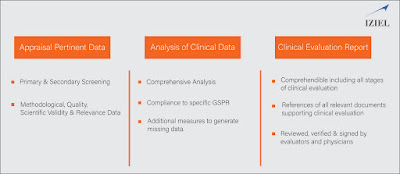
 The EU MDR has significantly impacted the way medical devices are regulated in Europe. As part of regulatory compliance, medical device manufacturers need to create and maintain a Clinical Evaluation Report (CER), a document essential for CE Marking. Here are expert tips on what to consider defining a robust CER strategy.   Clinical Evaluation Report (CER) makes a strong case for your device and its intended use backed by impactful scientific evidence. The aim of a CER is to reduce the risk that the users and patients are exposed to when using a medical device. Following are some steps to follow -   1.        Define a CER protocol and strategy   2.        Demonstrate equivalence   3.        Evaluate literature review data   4.        Determine requirement for clinical investigation   5.        Monit...

Manufacturers: time to shape up your CERs

Image
 Clinical Evaluation Report (CER) makes a strong case for your device and its intended use backed by impactful scientific evidence. The aim of a CER is to reduce the risk that the users and patients are exposed to when using a medical device. Clinical evaluation is an essential prerequisite for risk management. It justifies the assumptions made in the risk management file, with respect to the benefits and thus the acceptance of a certain risk-benefit ratio. When looking at the clinical evaluation of a new device, the available data will typically be limited. The evaluation will be based on the best available data at the time; however, the best indication of safety and performance will only be obtained once the device is in use. With the increasing lifespan of devices on the market, there will be increased need for clarity regarding the risk/benefit profile of the device. IZiel completes the Clinical Evaluation Report (CER) as per the following changes in revision Med-Dev Rev. ...